

Key takeaways
- For most couples and small groups on a two-week trip, a self-drive tuk tuk gives the best balance of cost, luggage room and legal simplicity.
- Scooters are the cheapest option and best for solo travelers who pack light, but motorcyclists are one of the highest road-death groups in Sri Lanka.
- Car hire is the comfort and distance choice for families or anyone covering long highway stretches, at the highest daily cost.
- Every foreign driver needs a local recognition permit from the Automobile Association of Ceylon plus an International Driving Permit from home.
- Tuk tuks and motorbikes cannot use expressways, so a car saves real time on long cross-island legs.
For two people with backpacks and two weeks to roam, a self-drive tuk tuk usually wins on cost, comfort and legal simplicity. The tuk tuk vs scooter Sri Lanka question really comes down to how many people you carry, how much you pack and how far you drive each day, so the right answer changes with your trip. This guide compares all three rentals on cost, comfort, road handling and permits so you can book the one that fits.
Before you pick, know that every foreign driver faces the same paperwork. A national license alone will not get you on the road here. You need an International Driving Permit from home and a local recognition permit, which we cover below.
Tuk tuk vs scooter Sri Lanka cost over a two-week trip
Across a 14-day trip, a scooter is the cheapest ride, a tuk tuk sits in the middle, and a car costs the most. Rental rates shift with season, vehicle age and rental length, so treat any single quote as a starting point rather than a fixed price.
As a rough guide based on rates across the self-drive market, scooters rent for the least per day, tuk tuks a step above that, and cars the most. Fuel follows the same order. A scooter sips petrol, a tuk tuk uses a bit more, and a car burns the most, especially on hill climbs. Add a deposit for any vehicle, and budget for the two permits every tourist must buy.
Three cost factors matter more than the headline daily rate:
- Length of hire. Weekly and multi-week rates per day are almost always lower than a single day.
- Fuel over distance. A big loop of the island means hundreds of kilometers, so a thirstier car widens the gap.
- Shared cost. Four friends splitting one car can beat two scooters once you divide the total.
If raw savings decide everything, the scooter leads. If you want a low running cost without riding exposed for two weeks, the tuk tuk is the sensible middle.
Comfort, luggage space and passenger capacity
A car wins on comfort and capacity, a tuk tuk gives useful shelter and modest storage, and a scooter offers the least of both. Your packing list and group size decide how much this matters.
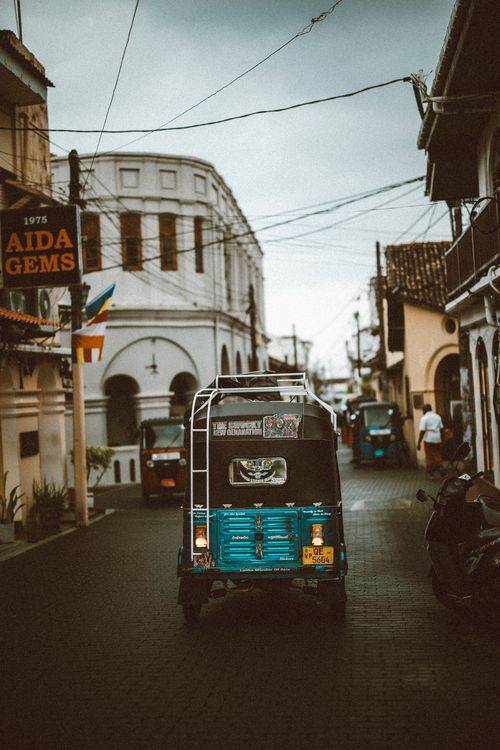
A scooter carries one rider comfortably, two at a squeeze, with a small underseat space and whatever fits on your back. A big suitcase simply does not work. A tuk tuk seats two adults in the rear bench with room for a couple of backpacks or a mid-size bag, and the roof and sides keep off sun and sudden rain. A car seats four or five with a proper boot, air conditioning and a quiet cabin for long days.
Rain changes the ranking fast. Sri Lanka's wet seasons bring heavy downpours, and a scooter leaves you soaked while a tuk tuk keeps you mostly dry. For families with children or anyone carrying hard luggage, the car is the clear comfort pick.
Handling hill roads and coastal routes
Each vehicle has a home turf. Scooters dart through traffic and tight lanes, tuk tuks hold their own on mixed roads, and cars feel safest at speed on open stretches and highways.
On the south and west coast, flat roads and short hops suit a scooter or tuk tuk perfectly. You can park almost anywhere and squeeze through beach-town lanes a car cannot. The classic coastal runs between surf towns are made for small, open vehicles, which is why so many travelers map out a string of beach-town hops before they arrive.
The hill country is a different test. Steep grades and switchbacks around the tea country ask a lot of a small engine. A tuk tuk climbs steadily if you are patient and travel light, a scooter manages with a single rider, and a loaded car has the easiest time on the gradients. If your plan centers on the highlands, read up on what the roads around Ella and the tea country are really like before you commit.
Road safety should weigh on this choice. Sri Lanka recorded 2,368 road deaths in 2024, and motorcyclists made up 732 of them, the second-highest group after pedestrians, according to National Council for Road Safety figures reported by The Morning. That same data set logged 7,854 motorcycle-involved accidents against 3,545 for three-wheelers through late November 2024. A tuk tuk puts a frame and roof around you that a scooter does not.
Licensing and permit differences
All three vehicles require the same two documents, so licensing rarely tips the decision on its own. You need an International Driving Permit from your home country and a Sri Lankan recognition permit issued locally by the Automobile Association of Ceylon.
The process is straightforward once you know the steps. Carry your home license, your International Driving Permit, your passport and visa, and passport photos. The recognition permit is issued quickly, often the same day, and is valid for the length of a typical holiday. One practical wrinkle matters for your choice: the airport permit counter does not cover three-wheelers, so a tuk tuk means arranging the permit through the association directly. A reputable rental company handles most of this for you. Our full walkthrough of the paperwork lives in the Sri Lanka tuk tuk driving permit guide.
Because the permit burden is nearly identical across vehicles, do not let paperwork alone steer you toward a scooter or a car. Pick on cost, comfort and route instead.
Best choice by traveler type and budget
The winner depends on who you are and how you travel, so match the vehicle to your trip rather than chasing one universal answer.
- Solo budget traveler packing light: a scooter. Lowest cost, easy parking, maximum nimbleness, as long as you accept the weather and the higher risk.
- Couples and pairs of friends: a self-drive tuk tuk. The best all-round balance of price, shelter, luggage room and the freedom to stop anywhere.
- Families or groups of four: a car. Seats, boot space, air conditioning and expressway access make long days bearable.
- Long highway distances in limited time: a car, because tuk tuks and motorbikes cannot use the expressways and must take slower A-roads.
- Short coastal or beach-town stays: a tuk tuk or scooter, both ideal for narrow lanes and frequent stops.
For the majority of visitors, who travel as a pair and want independence without riding exposed for a fortnight, the self-drive tuk tuk takes the overall win. It is cheap to run, carries your bags, shelters you from sun and rain, and reaches almost everywhere a car can on the routes most travelers actually drive.
Ready to decide? Map your route first, counting how many expressway-only long hauls you have against how many coastal and hill-town days. If coast and hill towns dominate, book a self-drive tuk tuk with Tuk Tuk Ceylon Ride, which arranges the permits and insurance so your paperwork is sorted before you land.
Frequently asked questions
Is a tuk tuk or a scooter better for touring Sri Lanka?
A tuk tuk suits two people with luggage and handles rain and rough roads better. A scooter is cheaper and nimbler but exposes you to weather and carries far more injury risk.
Do I need a special license to drive in Sri Lanka as a tourist?
Yes. You need an International Driving Permit from your home country plus a Sri Lankan recognition permit issued by the Automobile Association of Ceylon before you drive any vehicle.
Can I take a tuk tuk on the expressway in Sri Lanka?
No. Tuk tuks and motorcycles are barred from expressways. Only cars and larger vehicles may use them, so a tuk tuk trip relies on slower A-roads.
Which option is cheapest for a two-week Sri Lanka trip?
A scooter is usually the cheapest to rent and fuel, followed by a tuk tuk. Car hire costs the most per day, especially once you add fuel for a heavier vehicle.